I am writing this post to remember the day bright girls were far from each other but still were working together. Remember This post!
Now we live in the same house, study in the same university, and even do research in the same lab! We are going to do common projects, co-author papers, and share difficulties of life.
We will fall apart again next year, but again we will gather together, all of us, with all our family, and share enjoy of life :)
Tuesday, January 18, 2011

Tuesday, December 14, 2010

Sunday, November 15, 2009
Microbial Fuel Cells (MFCs) to scavange energy
MFCs can work anywhere bacteria live. The main idea is that anywhere microbes live, electrical power is produced as a product of their metabolism. The term microbe includes both aerobic and anaerobic microorganism such as bacteria, fungi and protozoa. MFCs convert chemical energy stored in organic matter directly into electricity by using natural metabolism of those microbes. They are used in low power levels between 0.1 to 10 watts.
As an example, MFC can be used for water treatment. It converts wastewater pollutants into electricity and produces clean water as well as electricity. In fact bacteria consume pollutant and produce electrons. These electrons then flow through a circuit and create electric current. the Australian beer maker Fosters and scientists at the University of Queensland applied MFCs to generate clean energy from brewery wastewater using sugar-consuming bacteria at a brewery near Brisbane, the capital of the state of Queensland. The process yield electric power that is large enough to run the treatment plant and product clean water as byproduct.
Structure of an MFC:
It has a similar structure to a battery and contains anode, cathode and electrolyte. At the anode, fuel is metabolized by microorganisms which generate electrons and protons. Electrons are then transferred to the cathode through an external electrical circuit to be stored. However protons go to cathode via electrolyte and are combined with the oxygen and electrons of water.

Advantages:
- Clean
- Renewable
- Low cost
- Efficient (far above 50%)
- Long life(for over 7 years)
- Autonomous and stable operation
- Minimal maintenance
- Wide range of operating environments from LED lights to sea-floors
- With focus in remote applications and specially Wireless Sensor Networks in industrial and harsh areas
Trophos Energy, get energy from soil, wastewater or microbes
Very interesting!
Get ENERGY from WASTE WATER, SOIL or HUMAN BODY's MICROBES!!
Trophos Energy, Inc. was founded in 2008 to research, develop and commercialize low cost, reliable remote energy harvesting systems based on Microbial Fuel Cell (MFC) technology. MFCs draw their energy from the natural metabolism of indigenous microbes, offering years of reliable, maintenance-free operation in organic-rich environments. Trophos' power management systems operate indefinitely when placed in soil, marine sediment or wastewater where solar, battery or other power sources may be technically or cost prohibitive.
Trophos leverages its proprietary technology to deliver power to wireless communication and sensor networks, offering new opportunities for military, water utility and industrial monitoring applications. Other applications include wastewater treatment and bio-remediation.
Tuesday, October 27, 2009
ECT100- thermal energy scavenging technology- even works in 2 centigrades diffrence
Product's website: http://www.tdc.co.uk/index.php?key=ect100
This is a product from EnOcean company in Germany.
EnOcean has developed a thermal energy harvester which is able to power wireless sensor nodes from temperature differentials of only a few Kelvin.
This new energy harvester ECT100 is based on a revolutionary DC/DC converter which automatically starts operation at 20mV.
ECT100 converts an input voltage in the range of 0.02V to 0.25V to an output voltage in the range of about 4V to 4.5V. The input voltage can e.g. be generated from a temperature differential using a peltier element.
The output power depends on the actual temperature difference between both sides of the Peltier element and the element being used. It ranges from μW to mW at 3.5V. Therefore ECT100 is designed for use with EnOcean radio technology in sensors and actuators.
It’s size is around 4 cm.

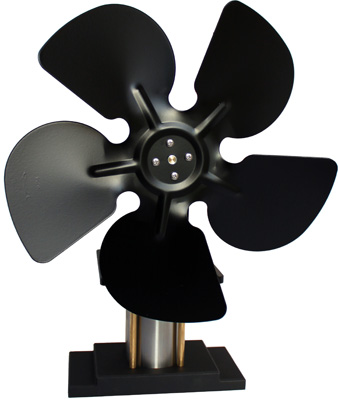
A fan working with heat
Also there is a fan for stove which works without any electric sources. It just works when the stove get hot. The Vulcan Stove fan goes fast when the temperature gets higher.
How It works?
It utilizes a small, quiet Stirling cycle power plant built into the fan.The Stirling cycle power plant obtains its power from rapidly heating and cooling the same volume of air. When the air is heated, it expands, pushing a piston upward; when the same volume of air is rapidly cooled, it contracts, pulling the same piston downward, providing power. The same volume of air is heated and cooled at a very rapidly converting the heat energy to mechanical energy used to turn the fan blade.
Of course it could be used also as an electricity producer. Circulation of fan can produce electricity. But I don’t know how much size it has and if it is possible to apply such an electric source in industrial environments for each sensor node. The product’s size is about 30X30 cm.

About harvesting energy from high tempreture
The technology to cleanly and quietly turn heat into electricity without the use of a turbine or generator has existed for nearly a century. The trouble is, it has never been efficient enough for widespread practical use.
I studied about Thermoelectric effect. There could be two methods two produce electricity from thermal energy.
First, by using stirling cycle power and converting thermal energy to mechanical energy(it is produced by difference in temperature and expanding and contracting. As a result a piston moves up and down and it is then converted to rotating energy) and then converting rotating energy to electrical power.
Second, by using Seebeck effect.(for more info see this article in wikipedia) The effect is that a voltage, the thermoelectric EMF, is created in the presence of a temperature difference between two different metals or semiconductors. This causes a continuous current in the conductors if they form a complete loop. The voltage created is of the order of several microvolts per kelvin difference. One such combination, copper-constantan, has a Seebeck coefficient of 41 microvolts per kelvin at room temperature. This little electricity can then be reproduced by DC/DC converters and finally be something about 3 or 4 volts. But the problem is that the ECT100(a thermal energy scavenging tech which I’ll introduce later) works with input voltage of at least several mv.
Sunday, October 25, 2009
UCLA Energy Scavenging Project
In this project they are trying to make extremely efficient energy harvesting. It means that they are trying to schedule energy harvesting such that the energy be used directly after harvesting and not to be stored in a battery and this is because storing in the battery adds the loss of battery storage and hence decreases efficiency.
It explains a method for efficient energy harvesting in practical distributed sensor networks and compares it with the optimum method which is not distributed and shows that the difference is not very much. There has been some publications based on this project but this project has been done on 2005 and 2006.
It explains a method for efficient energy harvesting in practical distributed sensor networks and compares it with the optimum method which is not distributed and shows that the difference is not very much. There has been some publications based on this project but this project has been done on 2005 and 2006.
Saturday, October 24, 2009
UCLA Energy Scavenging Project
The website is: http://research.cens.ucla.edu/projects/2005/Network_Autonomy/energy_scavenging/
Next time I will be surveying on this website and another one introducing a real project on energy resolutions for wireless sensor networks from Perpetua technology.
Next time I will be surveying on this website and another one introducing a real project on energy resolutions for wireless sensor networks from Perpetua technology.
Energy Harvesting Projects
Link to the paper: Download it!
This article discusses about current energy harvesting projects but unfortunately in year 2005! :D
I read all the article through and found out various energy harvesting possibilities like solar, piezoelectric, thermal, vibration, kinetic energy and even human passive activities.(It only introduces but not explain completely)
But the important part is that it introduces “Energy Scavenging” project in UCLA. I will then go through this project’s website and explain how they make a smart network which detects potentials of environment as an energy provider and then scavenges energy.
This article discusses about current energy harvesting projects but unfortunately in year 2005! :D
I read all the article through and found out various energy harvesting possibilities like solar, piezoelectric, thermal, vibration, kinetic energy and even human passive activities.(It only introduces but not explain completely)
But the important part is that it introduces “Energy Scavenging” project in UCLA. I will then go through this project’s website and explain how they make a smart network which detects potentials of environment as an energy provider and then scavenges energy.
Subscribe to:
Posts (Atom)

 Posts
Posts

