Tuesday, October 27, 2009

ECT100- thermal energy scavenging technology- even works in 2 centigrades diffrence


This is a product from EnOcean company in Germany.
EnOcean has developed a thermal energy harvester which is able to power wireless sensor nodes from temperature differentials of only a few Kelvin.
This new energy harvester ECT100 is based on a revolutionary DC/DC converter which automatically starts operation at 20mV.
ECT100 converts an input voltage in the range of 0.02V to 0.25V to an output voltage in the range of about 4V to 4.5V. The input voltage can e.g. be generated from a temperature differential using a peltier element.
The output power depends on the actual temperature difference between both sides of the Peltier element and the element being used. It ranges from μW to mW at 3.5V. Therefore ECT100 is designed for use with EnOcean radio technology in sensors and actuators.
It’s size is around 4 cm.


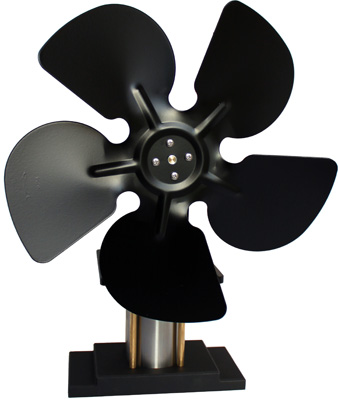
A fan working with heat


Also there is a fan for stove which works without any electric sources. It just works when the stove get hot. The Vulcan Stove fan goes fast when the temperature gets higher.
How It works?
It utilizes a small, quiet Stirling cycle power plant built into the fan.The Stirling cycle power plant obtains its power from rapidly heating and cooling the same volume of air. When the air is heated, it expands, pushing a piston upward; when the same volume of air is rapidly cooled, it contracts, pulling the same piston downward, providing power. The same volume of air is heated and cooled at a very rapidly converting the heat energy to mechanical energy used to turn the fan blade. 
Of course it could be used also as an electricity producer. Circulation of fan can produce electricity. But I don’t know how much size it has and if it is possible to apply such an electric source in industrial environments for each sensor node. The product’s size is about 30X30 cm.


About harvesting energy from high tempreture

The technology to cleanly and quietly turn heat into electricity without the use of a turbine or generator has existed for nearly a century. The trouble is, it has never been efficient enough for widespread practical use. 
I studied about Thermoelectric effect. There could be two methods two produce electricity from thermal energy.
First, by using stirling cycle power and converting thermal energy to mechanical energy(it is produced by difference in temperature and expanding and contracting. As a result a piston moves up and down and it is then converted to rotating energy) and then converting rotating energy to electrical power.
Second, by using Seebeck effect.(for more info see this article in wikipedia) The effect is that a voltage, the thermoelectric EMF, is created in the presence of a temperature difference between two different metals or semiconductors. This causes a continuous current in the conductors if they form a complete loop. The voltage created is of the order of several microvolts per kelvin difference. One such combination, copper-constantan, has a Seebeck coefficient of 41 microvolts per kelvin at room temperature. This little electricity can then be reproduced by DC/DC converters and finally be something about 3 or 4 volts. But the problem is that the ECT100(a thermal energy scavenging tech which I’ll introduce later) works with input voltage of at least several mv.

Sunday, October 25, 2009

UCLA Energy Scavenging Project

In this project they are trying to make extremely efficient energy harvesting. It means that they are trying to schedule energy harvesting such that the energy be used directly after harvesting and not to be stored in a battery and this is because storing in the battery adds the loss of battery storage and hence decreases efficiency.
It explains a method for efficient energy harvesting in practical distributed sensor networks and compares it with the optimum method which is not distributed and shows that the difference is not very much. There has been some publications based on this project but this project has been done on 2005 and 2006.

Saturday, October 24, 2009

UCLA Energy Scavenging Project

The website is: http://research.cens.ucla.edu/projects/2005/Network_Autonomy/energy_scavenging/
Next time I will be surveying on this website and another one introducing a real project on energy resolutions for wireless sensor networks from Perpetua technology.

Energy Harvesting Projects

Link to the paper: Download it!

This article discusses about current energy harvesting projects but unfortunately in year 2005! :D
I read all the article through and found out various energy harvesting possibilities like solar, piezoelectric, thermal, vibration, kinetic energy and even human passive activities.(It only introduces but not explain completely)
But the important part is that it introduces “Energy Scavenging” project in UCLA. I will then go through this project’s website and explain how they make a smart network which detects potentials of environment as an energy provider and then scavenges energy.

Effective Design of WSNs: From the lab to the real world

Link to the paper: Download it!

This paper discusses main characteristic of a credible WSN. For instance, energy harvesting, robustness and topology changes are the main issues in WSNs.
It introduces solar cells as energy harvesting parts in outdoor environments. As an example in marine monitoring and rock fall forecasting.
It introduces and examines previous works in this area and criticizes that a credible WSN is not only a prototype working well in laboratories and it needs to still work in real harsh environments. Also it needs to use non hazardous substances according to RoHS.
As it mainly discusses about outdoor harsh environments like bay, ocean, jungle,… and solar energy harvesting methods, I did not study it all and just had a glance.

But the main point is that I found its references very useful to research about harsh environments and energy harvesting methods. E.g. one of the references is “Energy Harvesting Projects” published by IEEE:
-See the next post-

Energy efficient secure pattern based data aggregation for wireless sensor networks

Link to the paper: Download it!

This paper discusses about a data aggregation protocol to decrease redundancy and hence increase bandwidth efficiency. This protocol is called: ESPDA: Energy Efficient Secure Pattern based Data Aggregation. This protocol eliminates redundancy by making all nodes with the same data sleep except for one. It is secured since cluster-head in this method do not need to know about sensor node’s data(the cluster head is in charge of broadcasting within the cluster). Hence sensor node sends encrypted data via the cluster-head to the base station and by establishing a secure end to end communication. This is the first protocol providing both security and aggregation together.
Finally it provides simulation results with C and using GloMoSim. Working on efficient generation of pattern codes is mentioned as future work.

Q: How does it do aggregation?
A: by using pattern code. Each node gathers data from all its sensing units, Makes a pattern code and sends it to cluster head. The cluster head gets all patterns from all its nodes and decides which node to sense data and send it. Then other nodes sleep.

Q: What is a pattern code?
A: A pattern code is made based on the main ideas of observed object. E.g. if the observed object is a picture of a human, the main recognition parameters for human is considered to create pattern code.

Q: How the Cluster head determines the best pattern code?
A: It has a sense of distinct pattern code based on the object being observed.

Q: How doesn’t the cluster head need to know about data sent by sensor node?
A: It only examines pattern codes and after that does not observe any data from the determined sensor node.

Q: How sensor node encrypts data without exchanging a key with base via cluster head?
A: each node has an id and also a secret key. Base station has a database of all ids and their secret keys. And this database is made in manufacturing phase. When a node sends information it sends its id also. Hence Base can decrypt data. To have a better security and ensure freshness, base broadcasts a common key named Kb in the network. All nodes XOR their secret key with Kb and hereafter use this new key.

Q: Encrypting algorithms needs process and consumes a high amount of energy. How is it energy efficient while using encryption?
A: It employs symmetric key cryptographic algorithms to ensure energy efficiency.

Summary of paper: Which wireless technology for WSN, OCARI technology

Link to paper: download here!

This paper introduces OCARI and asks for making this technology a global standard for industrial harsh environments. This method has been tested in several power plants and warships. Its advantages over previous methods which were mainly proposed by Zig Bee are deterministic MAC, energy optimization and mobility with the speed of man walking.

Application of WSNs in industrial harsh environments requires following characteristics in Physical and MAC layer:
1. robust radio transmission meaning low error regarding radio interferences. here we have a new variable named SINR= Signal to interference plus noise ratio.
2. Low power consumption
3. Compatibility with electromagnetic constraints.
4. deterministic MACs.

in Network layer:
1. Network topology flexibility
2. network scalability(for large or high density networks)
3. transparency like self configurable upon network parameters
4. support energy aware routing protocol
5. support mobility
6. authentication support

at APL layer:
1. support different profiles
2. different communication modes
3. support EDDL( electronic device description language)
4. authentication support

Existing industrial wireless communication standards
advantages of mesh networks include self-organizing and autoconfigurable topology. They also ease maintenance in industry and are cost effective. They are also suitable for CM or CBM(Condition-Base Monitoring).
disadvantage: most of them do not take into account industrial requirements.

previous Wireless standards: in this section 3 previous standards are introduced. for example
Zig Bee: for low data rate and low latency. long battery life. based on IEEE.802.15.4-2003 for PHY and MAC layers.
Zig Bee includes mechanisms for different layers. e.g. for NWK it includes routing, joining, leaving, security, ... .

After all, This is a very new technology. The first version was published on July 2009 and this version which I'm studying has been published just some days ago on October 2009 volume of IEEE.
So OCARI needs to be improved. As mentioned by authors it has some gaps specially in NTW and APL layers.

What is a harsh environment?

What is a harsh environment?
 It can be human or animals body
 North or south pole
 plains and deserts
 oceans
 fire alarm
 industrial harsh areas
 power plants
 warships

However we will mainly focus on industrial harsh environments. For industrial harsh environments there is a standard technology named OCARI(Optimization of Communication for Ad hoc Reliable Industrial networks). This technology supports mesh networks and power award ad hoc routing protocols. In its application layer(APL) it's compatible with zig bee(the only working group who has commercially available products for industrial wireless networks. It was founded very soon at the end of year 2004)

In the name of God!

Hi.
This post is just our first post in the area of Wireless Sensor Networks!
I ask God to help us study hard and do well in our projects, courses and presentations.
Our new life has begun recently and overcoming pressure of life sometimes is difficult.
Now Bright Girls are very far from each other but still working in the same area and still working together in contrast with the far distance of two opposite sides of the earth.
I finish this post with the name of God!